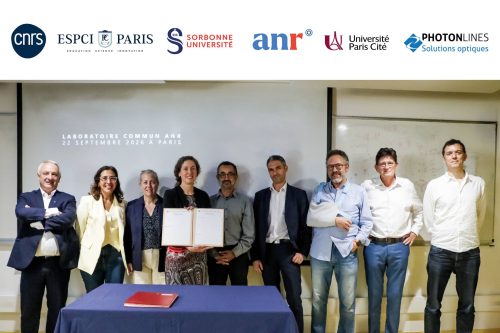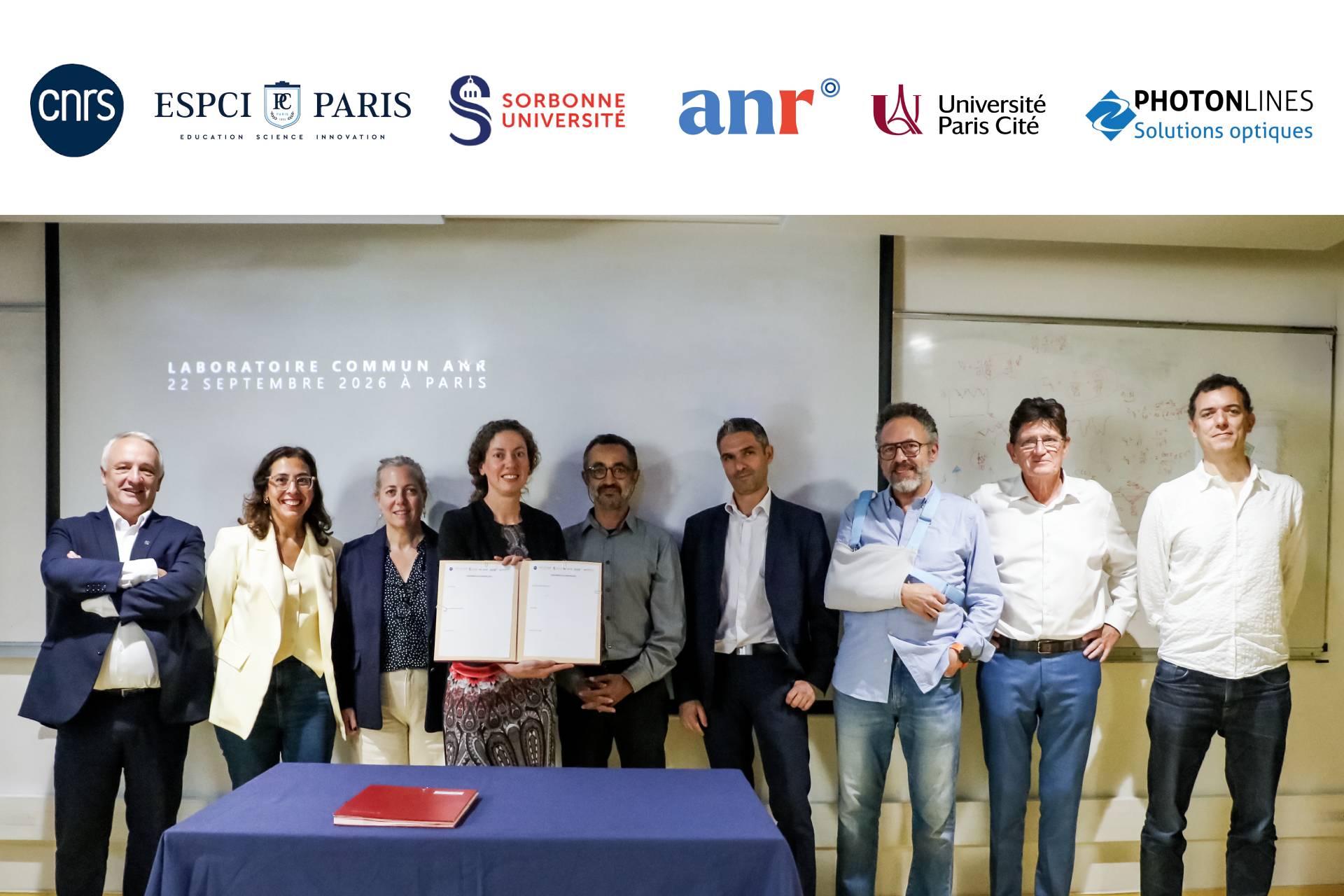
On September 22, 2026, in Paris, Photon Lines officially inaugurated the LIVO LabCom, alongside CNRS, ESPCI Paris-PSL, Sorbonne University and Université Paris Cité. This joint laboratory was established as part of the ANR LabCom programme, which supports long-term collaborations between companies and academic research institutions. The project benefits from €363,000 in funding over 54 months.
For Photon Lines, the creation of the LabCom represents an important milestone in our technological development. It enables an SME specializing in optical solutions and scientific instrumentation to strengthen its R&D capabilities by benefiting from additional human and material resources, as well as access to complementary scientific expertise brought together within the LabCom.
Eight years of collaboration behind the LIVO LabCom
The signing of the agreement does not mark the beginning of our collaboration with the academic community. On the contrary, it builds on eight years of joint work with the “Flow Control” team at the Physics and Mechanics of Heterogeneous Media laboratory (PMMH), under the joint supervision of CNRS, ESPCI Paris-PSL, Sorbonne University and Université Paris Cité.
Since 2018, this collaboration has notably been built around two CIFRE PhD projects, bringing together the laboratory’s scientific expertise and Photon Lines’ industrial know-how. This work led to the development of an optical velocimetry system capable of measuring fluid velocity in real time, at high frequency and high resolution. This system is now commercially available from Photon Lines.
The LIVO LabCom therefore represents a new step forward: having demonstrated the relevance of this technology and its industrial potential, the partners now have a structured framework in which to pursue its development and expand its applications.
GPU-accelerated optical flow: a breakthrough for real-time analysis
In fluid mechanics, Particle Image Velocimetry (PIV) measurements traditionally rely on cross-correlation processing performed after the experiment. Although widely used, this approach has limited spatial resolution and requires lengthy, computationally intensive post-processing, with no access to data in real time.
To address this challenge, the work carried out with the PMMH team has focused on integrating optical flow algorithms accelerated on graphics processing units (GPUs). This approach led to the development of the eyePIV solution. The system calculates 2D2C velocity fields in real time during the experiment, eliminating the need for deferred processing.
This methodological development provides high measurement resolution, making it possible to estimate motion with a precision of one velocity vector per pixel. The system is also highly versatile, as it can be used both with conventional particle imaging and with any dynamic textured image sequence (Textured Image Velocimetry).
Continuing development and expanding applications
Already used in fundamental research — including the real-time detection of rare turbulent events at the PMMH laboratory — the technology resulting from this work has the potential to extend to other fields of experimentation. It is particularly well suited to the study of complex flows in aerodynamics and transport, as well as in microfluidics and healthcare for the characterization of biological flows. Process engineering, ventilation monitoring and the analysis of geophysical flows also represent promising fields of application.
Over the 54-month duration of the LIVO LabCom, Photon Lines engineers and PMMH researchers will work closely together to enhance these tools with new analytical capabilities and support their transfer to new scientific and industrial applications.